The $60 Mistake in Your Laundry Basket
You finally found a bra that fits. It took three returns, a measuring tape, and a small identity crisis about whether you were actually a 32E instead of a 36C. It cost $58. You wore it for four months. Now the band is stretched into a hula hoop, the underwire is poking through the left cup, and the lace looks like it survived a tornado.
The bra did not die of natural causes. It was murdered in your washing machine.
Bras are the most delicate, most structurally complex, and most expensive items in your daily wardrobe. They contain elastic, underwire, molded foam, hook-and-eye hardware, and lace that can snag on a zipper from three feet away. Yet most of us toss them in with jeans and towels on a hot cycle and wonder why they retire before the season changes.
The good news: a bra that is washed correctly can last 12 to 18 months instead of 4 to 6. That is a 100% return on investment for an extra three minutes of effort.
Here is exactly how to do it — by hand, by machine, and by damage control when you are in a rush.
How Often Should You Actually Wash Your Bras?
This is the most common question, and the answer is not “after every wear.”
General rule: Wash a bra after 3 to 5 wears, or once per week if you rotate daily.
Wash immediately if:
- You wore it during exercise or on a hot day (sweat breaks down elastic)
- You spilled something on it
- You have skin sensitivity or are prone to breakouts under the band
- You are nursing (milk residue degrades fabric and smells)
The exception: If you own only two bras and wear them on alternating days, wash both at the end of the week. Elastic needs 24 hours to recover between wears. Wearing the same bra two days in a row is worse for its lifespan than washing it.
Method 1: Hand Washing (The Gold Standard)
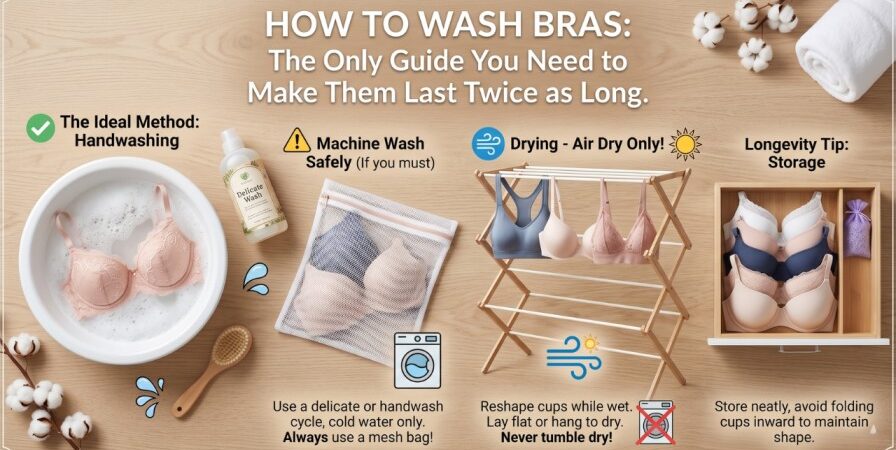
Hand washing takes four minutes and extends a bra’s life by months. It is the only method you should use for underwire bras, molded cups, lace, silk, or anything over $40.
What You Need
- A clean sink or basin
- Lukewarm water (never hot — hot water relaxes elastic permanently)
- A lingerie-safe detergent (see recommendations below)
- A clean towel
Step-by-Step
1. Fill the sink.
Use lukewarm water. The water should feel neutral to your wrist — not warm enough to relax in, not cold enough to flinch.
2. Add detergent.
Use a teaspoon of lingerie detergent or a few drops of baby shampoo. Swirl the water with your hand until it is slightly cloudy. Do not use regular laundry detergent; it is too alkaline and strips the elastic fibers.
3. Submerge and soak.
Place your bras in the water. Press them gently under the surface. Let them soak for 10 to 15 minutes. Do not swirl, scrub, or twist. Gravity and water pressure do the cleaning.
4. Spot-treat if needed.
If there is deodorant buildup on the band or underwire area, gently rub the fabric against itself with your fingertips. Do not use a brush.
5. Rinse thoroughly.
Drain the sink. Run lukewarm water over each bra until it runs clear. Press the bra gently against the sink wall to squeeze out water. Never wring. Twisting a bra is the fastest way to warp underwire or snap elastic.
6. Dry flat.
Lay a clean towel on a flat surface. Place the bra on top, reshape the cups with your hands, and roll the towel loosely to absorb excess water. Unroll and lay the bra flat to air dry, away from direct sunlight or heat vents.
Drying time: 12 to 24 hours. Plan your wash day so you are not stuck braless tomorrow morning.
Method 2: Machine Washing (The Realistic Method)
Let us be honest: most people will not hand wash every bra. If you are machine washing, you can still protect your investment by breaking one habit.
The One Rule That Saves Everything
Never put a bra in the machine unprotected.
An unprotected bra is a missile in a metal drum. The hooks catch on lace. The cups get crushed by jeans. The underwire bends against the drum wall. A $60 bra becomes a $60 rag in 45 minutes.
What You Need
- A lingerie wash bag with fine mesh (not coarse netting)
- A delicate or hand-wash cycle
- Cold water only
- Lingerie-safe detergent
Step-by-Step
1. Hook the bra.
Fasten the hooks behind the bra before you bag it. This prevents the hooks from snagging lace or other garments.
2. Place in a lingerie bag.
One bra per bag if possible. If you must double up, place molded cups back-to-back so they do not dent each other.
3. Use the delicate cycle.
Select cold water, low spin (400 RPM or less), and the shortest duration available. High spin cycles are underwire killers.
4. Skip the dryer sheet.
Fabric softener coats elastic fibers and makes them slippery, which reduces support. It also leaves residue that irritates skin.
5. Remove immediately.
Do not let bras sit in the machine. Molded cups can crease permanently if they are left crushed against the drum wall while wet.
Method 3: The “I Am in a Rush” Rescue
Sometimes life happens. If you need a bra clean and dry by morning, do this:
1. Spot-clean the band and underwire area.
Mix a drop of baby shampoo with water. Dab the high-sweat zones with a soft cloth. Rinse with a damp cloth.
2. Deodorize the cups.
Spritz the interior lightly with a 50/50 mix of water and vodka (plain, unflavored). Vodka kills odor-causing bacteria and evaporates without residue. This is a costume department secret used on Broadway.
3. Air it out.
Hang the bra by the center gore in a well-ventilated room. A fan speeds drying.
This is not a replacement for washing, but it buys you 24 hours.
The 5 Washing Mistakes That Kill Bras
Mistake 1: Using the Dryer
Heat is elastic’s worst enemy. A dryer on low heat is still hot enough to permanently relax the spandex in your bra band. Molded cups will warp. Underwire casings will shrink and trap the wire, causing it to poke through.
The fix: Always air dry. If you are in a humid climate, use a fan. Never hang a bra by its straps — the weight of the wet bra stretches the straps permanently.
Mistake 2: Using Regular Laundry Detergent
Standard detergents are designed for cotton and synthetic sportswear. They are too harsh for the delicate elastic and lace in bras. Over time, the fibers become brittle and snap.
The fix: Use a lingerie-specific detergent or a pH-neutral formula. See the recommendations below.
Mistake 3: Washing with Jeans, Towels, or Zippers
Heavy items act as sandpaper in the drum. Zippers and hooks are natural enemies. One cycle with a hoodie zipper can tear a lace panel completely.
The fix: Bras only travel with other delicates. If you do not have a full delicates load, hand wash or wait.
Mistake 4: Scrubbing Molded Cups
Molded cups (the foam-lined ones in T-shirt bras) are shaped by heat during manufacturing. Scrubbing them with a brush or twisting them to wring out water creates permanent dents and creases.
The fix: Press water out gently. Reshape the cups with your hands while damp. Dry flat.
Mistake 5: Wearing the Same Bra Two Days in a Row
This is not a washing mistake, but it is a care mistake. Elastic fibers stretch when warm and need 24 hours to contract back to their original length. Wearing a bra on consecutive days is like doing a workout without rest days — the material breaks down faster.
The fix: Build a rotation of at least three daily bras.
How to Store Bras Correctly
Washing is half the battle. Storage is the other half.
Molded cups: Stack them in a drawer like nested bowls. Do not fold one cup into the other — this creases the foam. If you must travel, use a hard-shell bra case.
Unlined/soft bras: Fold gently in half and stack. These can handle folding because there is no foam to dent.
Underwire bras: Never crush them. If your drawer is overstuffed, the wire can bend or the casing can tear.
Strapless bras: Store with the straps detached or wrapped around the band so they do not tangle.
The Bra Lifespan Timeline
Even with perfect care, bras expire. Here is what to expect:
| Bra Type | Lifespan (with proper care) | Lifespan (with poor care) |
|---|---|---|
| Daily underwire T-shirt bra | 12–18 months | 4–6 months |
| Strapless bra | 8–12 months | 3–4 months |
| Sports bra (high impact) | 6–9 months | 3 months |
| Lace/unlined bra | 18–24 months | 6–8 months |
| Molded cup bra | 12–15 months | 4–5 months |
When to retire a bra:
- The band is permanently stretched, even on the tightest hook
- The underwire is poking through the fabric
- The cups have lost their shape or are permanently creased
- The elastic makes a cracking sound when stretched
- You have owned and worn it weekly for over a year
Frequently Asked Questions
Can I wash bras with baby shampoo?
Yes, in a pinch. Baby shampoo is gentle and pH-neutral. Use only a few drops and rinse thoroughly. It is not as effective on oil and sweat as lingerie detergent, but it will not damage the fabric.
How do I get deodorant buildup out of bra bands?
Mix baking soda and water into a paste. Apply to the stained area, let sit for 15 minutes, then hand wash as normal. For stubborn buildup, use a soft toothbrush with the paste — but only on the band, never on cups or lace.
Can I wash a bra with pads/inserts?
Remove removable pads before washing. They hold water and take days to dry, which can mildew. Wash them separately in a small mesh bag.
What if my bra smells even after washing?
The smell is likely bacteria trapped in the elastic. Soak it for 30 minutes in a solution of one part white vinegar to four parts water before washing. Vinegar kills odor-causing bacteria and restores elastic bounce. Rinse thoroughly afterward.
Is dry cleaning safe for bras?
Only for silk, luxury lace, or heavily embellished pieces. The chemicals in standard dry cleaning are too harsh for everyday elastic. Most bras should be washed, not dry cleaned.
Final Thought: Care Is an Investment, Not a Chore
A well-cared-for bra costs less per wear than a cheap bra that dies in three months. If you spend $60 on a bra that lasts 18 months, that is 11 cents per day for support, comfort, and a silhouette that makes your clothes fit better.
Spend the extra three minutes. Use the lingerie bag. Lay it flat to dry. Your bras — and your bank account — will outlast the season.
Pin this guide to your laundry or cleaning board so you never forget the steps. And if you are not sure your bra even fits correctly to begin with, start here:
[Read: How to Measure Your Bra Size at Home — The Complete 5-Step Guide]